

Drones! Drones! Drones! Part 2: From Pickle Jars to Cruise Missiles: How Ukraine Out-Innovated the West
The corporate blindness of Western defence contractors, the rise of Fire Point, and the marketplace gamifying the front lines.

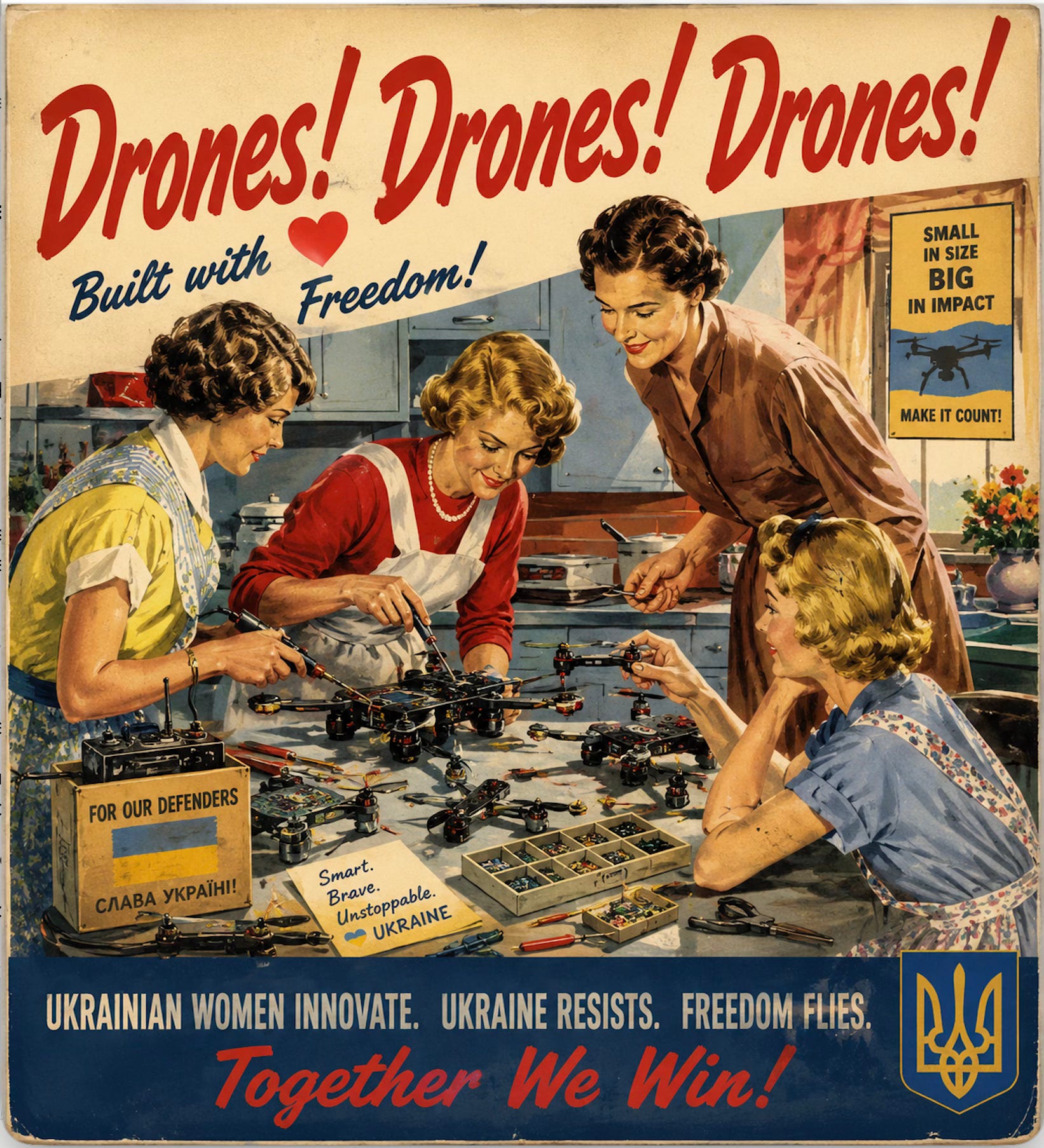
In the first days of Russia’s full-scale invasion of Ukraine, a woman named Elena was sitting on her balcony in Kyiv when she heard a drone nearby. She grabbed a jar of pickled plum tomatoes and threw it at the drone, knocking it out of the air. She and her husband destroyed what remained of the drone and scattered the wreckage across several garbage cans so it would not cut the paws of any dogs in the area.
Ukrainian analyst Liubov Tsybulska posted about it that day. “In Kyiv a woman knocked down a Russian drone from a balcony with a jar of cucumbers. How did they expect to occupy this country?”
Elena told the Ukrainian publication that reported the story: “This is my home, my land. I will stand, gnaw, fight, fight. All that is necessary.”
That was March 2022. Four years later, Ukrainian women are manufacturing the cruise missiles that strike targets 1,500 kilometres inside Russia. The distance between the pickle jar incident and today is the story of how Ukraine built the most consequential military innovation ecosystem of the past decade and why the CEO of Rheinmetall, one of Europe’s largest defence contractors, was walking back a contemptuous comment about Ukrainian innovation within 48 hours of making it.
At the end of March 2026, Armin Papperger gave an interview to The Atlantic. He was asked whether Ukraine was good at building weapons. He said it was Ukrainian housewives. They had 3D printers in their kitchens. They produced parts for drones. This, he suggested dismissively, was not innovation.
Within hours, “made by housewives” was a viral hashtag in Ukraine. Alexander Kamyshin, Zelensky’s special adviser on defence production, responded directly: those housewife-made drones had already destroyed more than 11,000 Russian tanks. Within 48 hours, Rheinmetall issued a statement. “We have the utmost respect for the Ukrainian people’s immense efforts in defending themselves. It is to Ukraine’s particular credit that it is fighting highly effectively even with limited resources.”
Papperger, Rheinmetall’s CEO, had totally misjudged the situation.
The question worth asking is why Ukraine’s model produces what it does, and what that means for every country trying to build a defence capability without a war forcing the issue. For Canada, the question is more acute: how much of our defence industry looks like Rheinmetall, and how much of it looks like Ukraine?
This is Part 2 of a five-part Deep Dive series. Part 1 is free. Parts 2 through 5 are for paid subscribers.
Below the paywall, we dive deep into the mechanics of Ukraine’s defense transformation. You will unlock:
The Tech: How Edena built Fire Point and engineered the Flamingo cruise missile.
The Marketplace: Inside Brave1, the e-commerce app gamifying the front lines with a literal “points-for-tanks” reward system.
The Canadian Lesson: Why Western defense giants are blind to this model, and what it means for Canada’s military readiness.
