

Drones! Drones! Drones! Part 1: The Battlefield Is Everywhere
Ukraine’s drone war has collapsed the distinction between front line, rear area, and safe zone. From $400 FPV drones to AI-guided weapons and ground robots, this is the new battlefield.

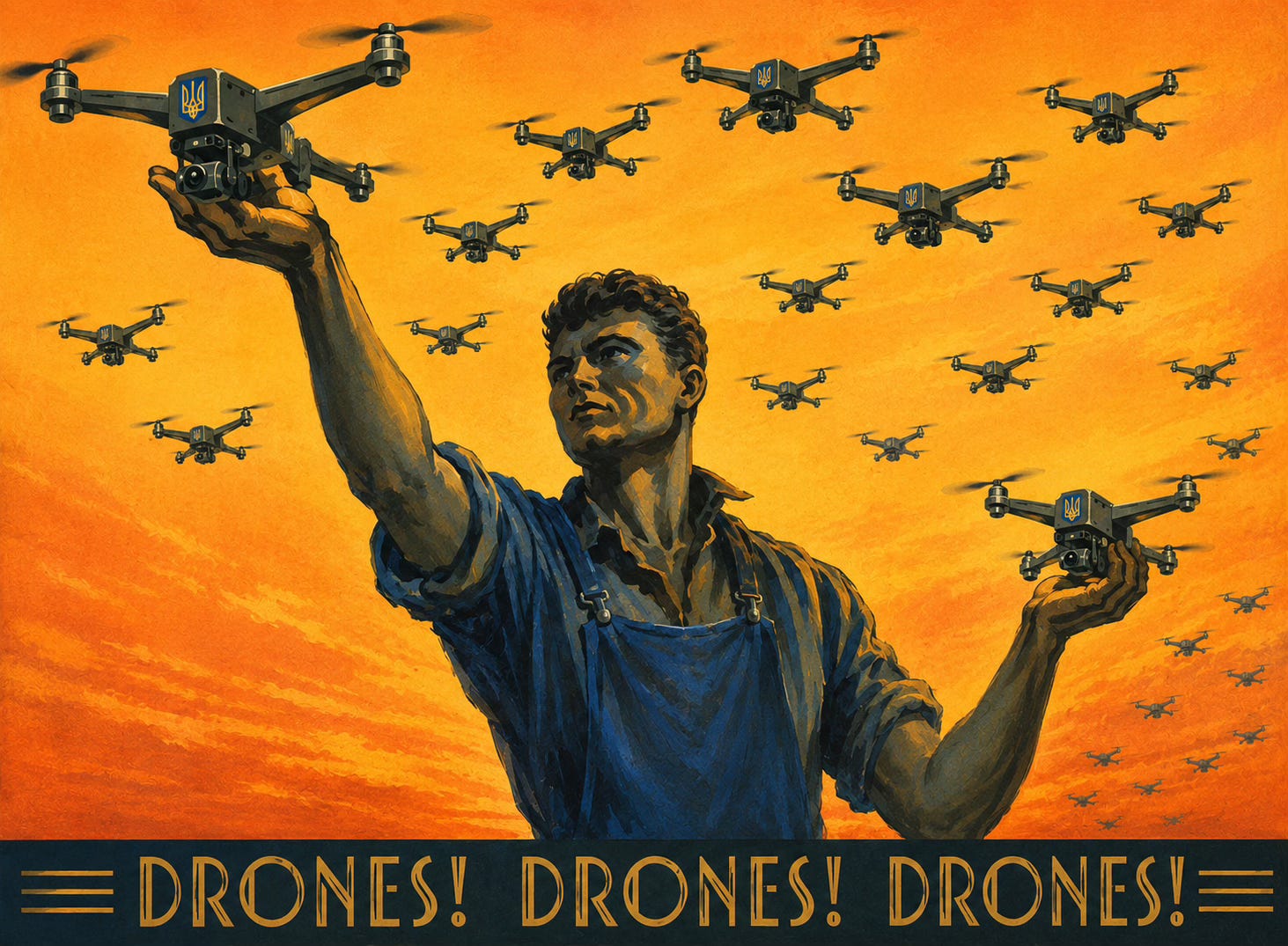
On the night of May 13, 2026, Russia fired 675 attack drones and 56 missiles in a single overnight attack. Kyiv bore the brunt of the attack. Air raid alarms sounded for eleven hours. A nine-storey apartment building was flattened. At least twenty-four people were killed. Ukrainian President Zelensky reported that Russia had fired more than 1,560 drones at Ukraine in the preceding thirty-six hours: the largest aerial bombardment of the war.
Three weeks earlier, on April 13, Ukrainian forces captured a Russian-held position. No Ukrainian soldier crossed the line of departure. No medevac was called. FPV drones struck the position first, then ground robots rolled in. Russian soldiers surrendered to machines. Zelensky called it the first time in the history of the war that an enemy position had been taken exclusively by unmanned platforms. His forces reported that ground robots had completed more than 22,000 frontline missions in the preceding three months.
These two events, one a massive conventional bombardment and the other a surgical operation without a single soldier at risk, describe the same evolution. Drone warfare has changed who fights, how they fight, where they are safe, and what it costs to win or lose. The technology is new and the terminology is different.
Over five parts, we are going to look at what drone warfare actually is, what Ukraine has proved about how it works, and how all of this impacts decisions Canada must make for our defence and preparedness. This first piece is the foundation. By the end of it you will have the vocabulary and understanding to follow everything that comes next, in this series and in the news.
Not all drones are the same
The word drone covers a range of technology. Understanding the categories (what each type does and where it operates) is the foundation for understanding why this changes everything.
Commercial surveillance and bomber drones are the eyes of the infantry. Off-the-shelf quadcopters like the DJI Mavic 3, available to any civilian for a few hundred dollars, became one of Ukraine’s most important early military tools. Soldiers use them to observe troop positions, direct artillery fire, and track movement in real time. Many are modified to drop grenades or small mortar bombs onto exposed enemy positions. Early in the conflict, Ukrainian forces were sourcing these through civilian networks because formal procurement could not move fast enough. Russia and Ukraine each operate thousands of them daily. Cost: $2,000
FPV kamikaze drones (first-person view) are small, fast quadcopters rigged with explosive charges. The operator flies them wearing goggles that display a live feed from the drone’s camera, steering with precision into vehicle hatches, windows, trenches, or troop concentrations. Ukraine is producing them at more than 200,000 per month. They are now responsible for the majority of armoured vehicle losses on both sides of the conflict. Cost: $200-$500
Heavy bomber drones, known in Ukraine as “Baba Yaga,” are large multi-rotor agricultural hexacopters or octocopters repurposed for combat. They operate primarily at night using thermal imaging to locate targets, dropping anti-tank mines, mortar rounds, and heavy munitions on fortifications and equipment. They are slow and loud but carry payloads that FPV drones cannot. Cost: $8,000
Loitering munitions are launched into a target area, circle autonomously until they identify a target, and then strike. They carry larger warheads and operate at greater range than FPV drones. The American-made Switchblade, which Canada is deploying with its Latvia battlegroup, is one example. Cost: >$10,000
Medium-range strike drones are the dominant battlefield story of 2026. Operating at depths of 100 to 300 kilometres behind the front line, these drones target logistics nodes, fuel depots, command posts, and supply routes in what armies used to consider safe rear areas. Since January 2026, Ukraine has significantly expanded its use of medium-range strike drones, targeting Russian logistics and supply routes at depths previously considered safe. Ukrainian mid-range drones operating day and night, striking with little warning, are creating logistical paralysis along rear-line routes around Donetsk and Luhansk. Cost: $2,000 - $60,000
Long-range one-way attack (OWA) drones function as low-cost cruise missiles. They strike targets hundreds of kilometres away: oil refineries, airfields, military production facilities. Russia’s Shahed series and Ukraine’s Flamingo are both in this category. Ukraine’s Flamingo struck a Russian military-industrial facility 1,500 kilometres inside Russia in May 2026.These are expensive relative to FPV drones but dramatically cheaper than the assets they destroy. Cost: $55,000-$500,000
MALE drones (Medium-Altitude, Long-Endurance) are larger fixed-wing aircraft like the Turkish-made Bayraktar TB2. Highly effective in the early war for striking Russian armoured columns in the open, their operational role has since narrowed significantly. Modern air defence systems make them too vulnerable for front-line strike missions. They now serve primarily in surveillance and Black Sea monitoring roles. Canada’s MQ-9B SkyGuardian, based at 14 Wing Greenwood in Nova Scotia, falls into this category. Cost: $5M-$245M
Interceptor drones are a fast-growing specialized class. Ukraine deploys quadcopter interceptors, including the “Sting” (capable of 160 kilometres per hour at altitudes up to 3,000 metres), to hunt and destroy Russian FPV and reconnaissance drones mid-air. They use camera mounts, explosive payloads, or in some cases shotguns mounted to the airframe. Interceptor drones are a cheaper alternative to missiles for downing Shaheds and have become a standard layer of Ukrainian air defence. cost: $1,000-$4,000
Naval drones are uncrewed surface and underwater vessels. Ukraine’s Magura V5 and Sea Baby drones have struck Russian warships and port infrastructure throughout the Black Sea campaign. In December 2025, a submarine variant penetrated defences at Novorossiysk harbour and disabled a $400 million Russian submarine. Cost: $250,000
Ground robots are the newest and fastest-growing category. Ukraine’s TerMIT, Zmiy, Protector, and Ratel H systems handle ammunition delivery, casualty evacuation, mine-laying, fire support, and assault operations. One manufacturer, Tencore, delivered more than 2,000 ground robots in 2025 and projects demand of roughly 40,000 in 2026. On April 13, 2026, ground robots and drones captured a Russian position without a single Ukrainian soldier crossing the line. Cost: >$20,000

How drones are controlled, and why it matters
The airframe is only half the story. How a drone is guided to its target determines whether it can be jammed, hijacked, or blinded. The contest between control technology and countermeasures is where the real arms race is being fought.
Radio control is the baseline. An operator on the ground sends signals to the drone through a radio link. It works, it is simple, and it is the standard method for most FPV operations. It is also jammable. Russian electronic warfare units deploy systems that flood the radio spectrum, severing the link between operator and drone. A jammed FPV drone falls out of the sky or flies in a straight line until it crashes.
Fiber-optic cable was Ukraine’s answer to radio jamming. The drone carries a spool of hair-thin optical cable that unspools behind it as it flies. Control signals travel through the cable as pulses of light rather than radio waves. There is no radio frequency to jam. The drone operates through the densest electronic warfare environment on earth as if it does not exist. Range is limited by cable length, typically a few kilometres, but within that range the drone is effectively unjammable. Russia is now developing its own fiber-optic FPV drones.
GPS navigation guides longer-range drones to their targets using satellite positioning signals. It is accurate and reliable under normal conditions. It is also spoofable. Russian electronic warfare systems can broadcast false GPS signals that convince a drone it is somewhere it is not, sending it off course or into the ground. Ukraine responded by developing inertial navigation systems and terrain-matching software that do not depend on GPS.
AI vision guidance is the most significant recent development. Ukrainian company Fourth Law has developed an AI targeting module costing approximately $70. The operator designates a target on screen; the AI locks onto it visually and guides the drone to impact without any external signal at all: no radio, no GPS, no cable. The drone is immune to jamming because it requires no communication once the target is locked. This technology was developed, tested, and deployed in a combat environment within weeks.
Mesh networks are the communications layer for swarm operations. Rather than each drone communicating individually with a ground operator, mesh-networked drones communicate with each other, sharing position, target, and status data. If one drone is jammed or destroyed, the network routes around it. Ukraine is actively sourcing mesh modem developers. Swarmer, a Ukrainian autonomy software company that went public on Nasdaq in March 2026, has run more than 100,000 real combat missions using collaborative autonomy software that allows operators to set an objective and let the system distribute tasks among drones automatically.
Starlink has also been part of the picture. Russia exploited Starlink satellite links to extend drone control range until access restrictions were imposed in early 2026. Both sides continue to probe satellite communications as a control layer.
Each control method solves the vulnerability of the previous one and creates a new one. Radio is jammed, so Ukraine develops fiber-optic. GPS is spoofed, so Ukraine develops AI vision. AI vision requires no signal, so Russia is developing optical countermeasures. Mesh networks distribute communication, so Russia targets the network infrastructure. The cycle runs continuously, and the side that cannot keep pace with it is always fighting the last version of the threat.
The cost-ratio revolution
Military planners have always thought in cost-exchange terms: what does it cost me to destroy what you have built? Drone warfare has compressed those ratios to a point that restructures the logic of conventional platforms.
A Russian T-90 tank costs approximately $4.5 million. A Ukrainian FPV drone costs $400. When a $400 device can reliably destroy a $4.5 million asset, the tank becomes a liability unless it can be protected against the drone, and that protection is itself expensive. The arithmetic extends across the battlefield. A $250,000 naval drone can sink a $65 million warship. In 2025, 117 Ukrainian drones struck Russian strategic bombers at Saratov-Bezymyanka airfield and inflicted approximately $7 billion in damage.
The implication is huge. A country that can field thousands of cheap, replaceable systems forces any adversary to spend heavily on defence against them, while simultaneously threatening assets that took years and billions of dollars to produce. Ukraine, with a population of 40 million facing a country of 140 million with a defence industrial base that dwarfs its own, has used this to sustain a war now entering its fifth year.
The battlefield is everywhere
Before drones became ubiquitous, armies could move under cover of darkness, use terrain, and reposition before an adversary knew a unit had left. Rear areas were, by definition, behind the fight.
That assumption has collapsed. Persistent drone surveillance means that movement is observable, positions can be tracked over time, and the distinction between the front line, the rear area, and the safe zone no longer holds in the way doctrine assumed it would. General Vasyl Syrotenko, commander of Ukraine’s army engineering units, said it this spring: unmanned systems can reach them all.
The practical consequence for armies is that concentration is dangerous. A massed formation is a target. A fixed command post is a target. A supply convoy on a predictable route is a target. The tactical disciplines drone warfare requires, dispersal, constant movement, electronic silence, and decentralized decision-making, run directly counter to the organizational habits of most large conventional militaries.
The Kill Chain
In military doctrine, the kill chain is the sequence of steps required to move from locating a target to destroying it. For example: a reconnaissance patrol spots an enemy tank column. They radio the coordinates up the chain of command. An officer authorizes an airstrike. A pilot is scrambled, briefed, and routed to the target. By the time the strike arrives, the column has moved. The kill chain took six hours.
Find, identify, track, strike, engage, assess result. That sequence could take hours or days, involving multiple specialists, layers of command authorization, and significant coordination between units.
Drone warfare has reduced the kill chain time to minutes, sometimes seconds. An FPV operator spots a tank through a surveillance drone feed, locks an FPV onto it, and strikes, as a single continuous action by one person.
In drone warfare, mass formations are targets because they are easy to find and track. Fixed positions such as command posts, logistics hubs, and maintenance facilities are targets because they can be located and struck before they move. Large, slow-moving supply convoys are targets for the same reason.
The tactical response Ukraine has developed is dispersal, constant movement, decentralized command, and electronic silence. These are organizational habits that run counter to most large conventional militaries. Ground robots extend the air drone capabilities. Ukrainian robotic systems completed 9,000 frontline missions in March 2026 alone. The number of units deploying them grew from 67 to 167 in five months. Every robot mission is a kill chain without a soldier in front. Although tanks, artillery, and air power remain part of how wars are fought, they must be designed and operated with the new kill chain compression in mind.
The innovation speed problem, and how Ukraine solved it
The weapon itself matters less than how fast it evolves. This is the aspect of drone warfare hardest to communicate and most important to understand.
When Russia deployed electronic warfare systems that jammed the GPS signals Ukrainian drones depended on for navigation, Ukrainian engineers did not wait for a formal procurement cycle. Within weeks, they produced fiber-optic guided drones that carry a spool of hair-thin optical cable behind them as they fly. Control signals travel through the cable as pulses of light rather than radio waves. There is no radio frequency to jam. The drone operates in the densest electronic warfare environment on earth as if it does not exist.
When fiber-optic cables solved the jamming problem but not the GPS navigation problem, Ukrainian company Fourth Law developed an AI vision module at approximately $70 per unit. The operator designates a target on screen; the AI locks onto it visually and guides the drone to impact without any external signal. Tested and deployed in combat in weeks.
Ukraine iterates drone designs every four to eight weeks based on direct frontline feedback. Russia adapts. Ukraine adapts again. The cycle is continuous. A military that cannot match that iteration speed is always fighting the last version of the threat.
Ukraine formalized that feedback loop through Brave1, a government procurement marketplace that functions like an e-commerce platform for frontline units. Units upload verified strike footage to Ukraine’s DELTA battlefield awareness system and earn points redeemable directly for drones, optics, and electronic warfare equipment. Destroying a tank earns 40 points. Capturing a Russian soldier alive earns 120. The system has processed orders for more than 80,000 drones worth over $96 million. Equipment that fails in the field gets poor ratings and loses orders. Manufacturers whose products work get more. Brave1 marketplace information drives production decisions within days.
Ukraine went from seven domestic drone manufacturers before the February 2022 invasion to more than 2,000 manufacturers and military technology firms by 2026, under bombardment, with a wartime economy and a systematically attacked electrical grid.
What comes next
Drone warfare has changed not just how wars are fought but how they can be deterred.
A country that can field thousands of cheap, rapidly evolving systems imposes costs on any potential adversary, even a much larger one, before a single shot is fired in a conventional sense. Deterrence no longer requires matching an adversary platform for platform. It requires the capacity to make any attack prohibitively expensive through mass, speed, and continuous innovation, and the industrial infrastructure to sustain that capacity before it is needed.

Michael Kofman, one of the most authoritative analysts of the Russia-Ukraine war, described the current battlefield in an April 2026 War on the Rocks episode as “a dispersed contest over a vast kill zone” where drone warfare has fundamentally transformed how forces move, communicate, and survive. That description captures where the technology is today. It does not capture where it is going.
Ukraine’s Defence AI Center, established in April 2026, is working toward a networked battlefield in which autonomous systems operate in coordination under a unified AI assessment platform. Its head, Danylo Tsvok, told the Associated Press that such a system could be operational within three to five years. Drone swarms capable of coordinated autonomous operation, where each platform knows what the others are doing and adapts accordingly, are in testing. Mass deployment is a few years out. When it arrives, the cost-exchange ratios described in this piece will compress further.
Canada is not a bystander to any of this. Canada has the world’s longest coastline, three ocean approaches, an Arctic frontier under increasing pressure, and a population of 38 million people spread across a continental landmass. The forces that matter in drone warfare (persistent surveillance, cheap mass attrition, software-driven adaptation, and the industrial capacity to iterate continuously) are exactly what a country with Canada’s geography and resource constraints should be developing.
Advances in computing, artificial intelligence, and optics have transformed drones from surveillance tools into the defining weapons of the current era. That transformation has reshaped how wars are fought, how countries deter aggression, and what it means to defend sovereign territory. The battlefield is no longer a place. It is everywhere that a drone can reach, which is nearly everywhere. For Canada, that is a direct question about whether this country has the industrial capacity, the procurement culture, and the institutional will to protect what is ours. That is what this series examines.
"Rather than large numbers of people operating small numbers of heavily manned machines, the future force should consist of smaller numbers of people operating much larger numbers of highly intelligent unmanned machines." ~ Christian Brose, The Kill Chain: Defending America in the Future of High-Tech Warfare
The series continues next week with Part 2: The Housewives Are Winning. Ukraine’s decentralized, civilian-led innovation model and what it proved about democracy, diversity, and the future of war.
Incredible information. Read this if you think drones are just drones … war is irrevocably changed.